
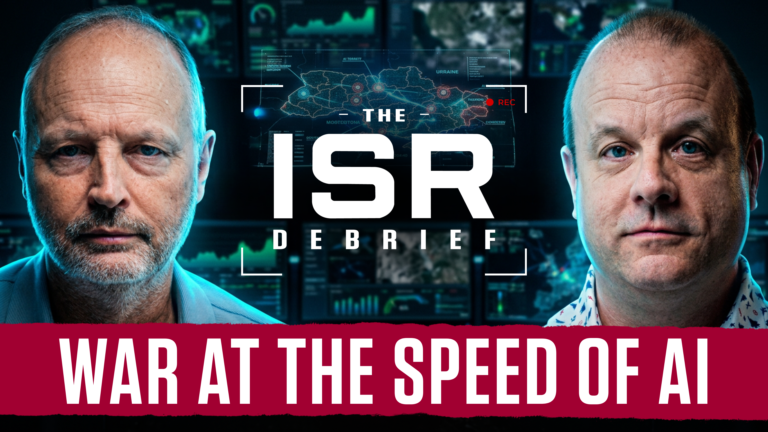
The next major conflict won’t be decided by the biggest platform or the newest weapon system. It will be decided by whoever can sense, understand, and act faster than the adversary. That is the central argument of the inaugural episode of The ISR Debrief, the new podcast from Integrity ISR, where host Wesley Rose sits down with Chad Hartman — Senior Vice President of Global ISR Solutions at Integrity ISR and a retired U.S. Air Force intelligence colonel who served as NATO’s targeting and collection management authority.
Across more than 30 years in ISR, special operations, and targeting, Hartman has watched the character of war change — but rarely as fast as it is changing now. The episode opens with a tour of the developments shaping the current national security landscape: Russia’s shift toward deep-strike operations against Ukrainian population centers, the ongoing strike exchanges between the United States and Iran, and a quieter but telling incident in the Pacific, where a Dutch frigate conducting freedom-of-navigation operations in the South China Sea was pressured out of the area by Chinese electronic warfare. Each, Hartman argues, is a data point in the same larger story: modern conflict is becoming faster, more distributed, and more dependent on the ability to find and understand targets before the other side does.
That leads to the episode’s core thesis. “The side who sees first wins,” Hartman explains — and in a world saturated with long-range precision fires, the hard part is no longer striking a target but finding it. Forces can no longer dig in and hold ground; survival depends on staying mobile, agile, and dispersed. That mobility, in turn, places an enormous premium on ISR: the ability to sense across every domain, fuse that information at speed, and hand a decision-maker a viable solution faster than the adversary can react.
Hartman is careful to distinguish the platform from the architecture. The decisive capability, he argues, is not the newest aircraft, ship, or missile — it is the ISR architecture that links sensors to shooters and stitches individual kill chains into a broader “kill web.” Whoever can execute the find, fix, track, target, engage, and assess cycle more efficiently holds the advantage.
Looking toward a potential Pacific conflict, Hartman outlines what would be different: a maritime fight across vast distances with fewer natural chokepoints, demanding autonomous maritime ISR operating not for hours but for months, and dynamic targeting conducted at a tactical tempo but a theater scale. Success there, he notes, will require the United States and its Pacific allies to embrace decentralized execution under centralized intent — pushing authority to the edge so decisions can be made in seconds, not days.
The episode closes on the reason Integrity ISR launched the show in the first place: to help the professionals who do this work understand what matters, and why, in an operating environment that is evolving faster than doctrine can keep up.
The ISR Debrief is produced by Integrity ISR, with education and professional development powered by ISR University. New episodes explore the developments, technologies, and lessons shaping intelligence, surveillance, reconnaissance, targeting, space, and electronic warfare.
Learn more at https://integrityisr.com y https://isruniversity.com


 Spanish
  English
  Arabic
  Portuguese
  Japanese