
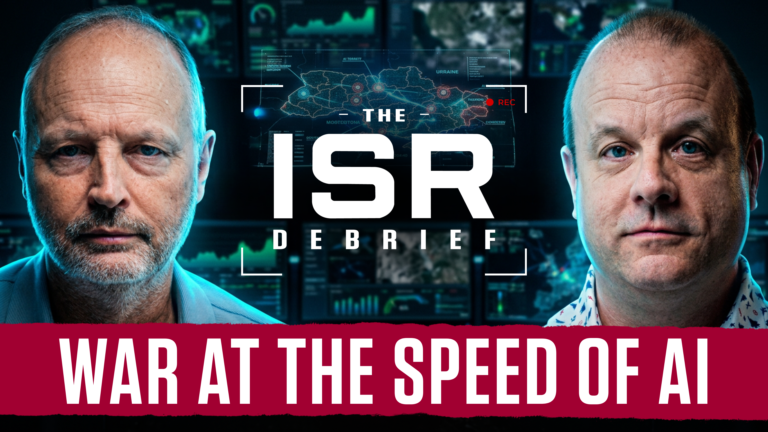
As the tools of warfare change faster than the doctrine written to govern them, one question is quietly reshaping the intelligence community: are we training professionals for the fight that’s coming, or the one we already fought? In the third episode of The ISR Debrief, host Wesley Rose convenes three leaders with nearly a hundred years of combined experience to answer it — Chad Hartman, Jason “Stutz” Stutzman, and Jeff “Monty” Montgomery, all retired U.S. Air Force intelligence officers now leading training and solutions at Integrity ISR.
The discussion begins with the intelligence cycle — the planning, collection, processing, analysis, and dissemination loop that has anchored analytical training for generations. The panel agrees it remains a valuable conceptual framework, but questions whether it still holds up operationally when decisions that once took hours now happen in seconds at the tactical edge. Montgomery captures the training challenge in a line: “You’ve got to know the rules to break the rules.” Foundational doctrine matters, but the edge comes from teaching warfighters to deviate from it — with discipline and good judgment — faster than the adversary can.
A recurring theme is the primacy of people over tools. As Hartman puts it, the military takes “the greatest automated tool ever created, the human mind,” trains it to develop critical thinking and intuition, and then too often sits that person in front of a screen doing work a machine could do. The real promise of AI, he argues, is to strip away the mundane and unleash the human to apply judgment at a higher level — the human-machine interface done right.
The conversation confronts the cost-asymmetry crisis defining today’s battlespace. Stutzman points to the exchange now filling headlines: inexpensive one-way attack drones forcing million-dollar interceptor responses. “That’s not a tenable position,” he says. “We cannot sustain that.” Adversaries, he notes, are finding ways to bleed advanced militaries dry financially without ever meeting them head-on.
On artificial intelligence, the panel is both optimistic and cautious. AI is a powerful tool, but as Montgomery warns, it is only as trustworthy as the data behind it — garbage in, garbage out. The new critical skill is validation: knowing whether the output, and the source, can be trusted. Or, as Stutzman summarizes the whole episode: “A good analyst is still a good analyst.” The tools change; the fundamentals — research, challenging assumptions, evaluating sources — do not.
Asked for the single most important skill for the modern intelligence professional, the three answered in one word each: motivation, adaptability, and judgment.
The ISR Debrief is produced by Integrity ISR, with education and professional development powered by ISR University.
Learn more at https://integrityisr.com e https://isruniversity.com.


 Portuguese
  English
  Spanish
  Arabic
  Japanese