
Space Power Begins on the Ground

The space community spends enormous energy protecting satellites in orbit — and comparatively little protecting the factories, launch sites, and supply chains that make space power possible. In a special in-person episode of The ISR Debrief recorded in Los Angeles, host Wesley Rose brings together the team behind The Integrity Flash to ask a question few are focused on: are we defending space power in the wrong place? Chad Hartman leads the discussion with three of the Flash’s space and counterspace analysts — Greg Gillinger, Senior Vice President for Strategy and Development at Integrity ISR; Alison Sayer, an Air Force veteran focused on space security and counterspace threats; and Ron […]
Training for the Next Fight: Why “A Good Analyst Is Still a Good Analyst”
As the tools of warfare change faster than the doctrine written to govern them, one question is quietly reshaping the intelligence community: are we training professionals for the fight that’s coming, or the one we already fought? In the third episode of The ISR Debrief, host Wesley Rose convenes three leaders with nearly a hundred years of combined experience to answer it — Chad Hartman, Jason “Stutz” Stutzman, and Jeff “Monty” Montgomery, all retired U.S. Air Force intelligence officers now leading training and solutions at Integrity ISR. The discussion begins with the intelligence cycle — the planning, collection, processing, analysis, and dissemination loop that has anchored analytical training for generations. […]
NATO’s AI Targeting System Is Live — and the Question of Who Pulls the Trigger
The 2026 NATO Summit produced a wave of announcements that will shape coalition warfare for years. In the second episode of The ISR Debrief, host Wesley Rose and Chad Hartman are joined by retired U.S. Air Force Colonel Tom Dobbs — who spent 33 years leading intelligence organizations across the Pacific, Europe, Africa, and the National Geospatial-Intelligence Agency — to break down what those announcements actually mean. The conversation opens with the headline out of the summit: a U.S. decision to authorize licensing of Patriot missile production in Ukraine. Dobbs frames it as a move driven by hard supply realities. Years of high-intensity use in Ukraine, compounded by depletion tied […]
China’s SJ-31 Satellite In Position to Monitor GEO from an Unusual Highly Elliptical Orbit (HEO)
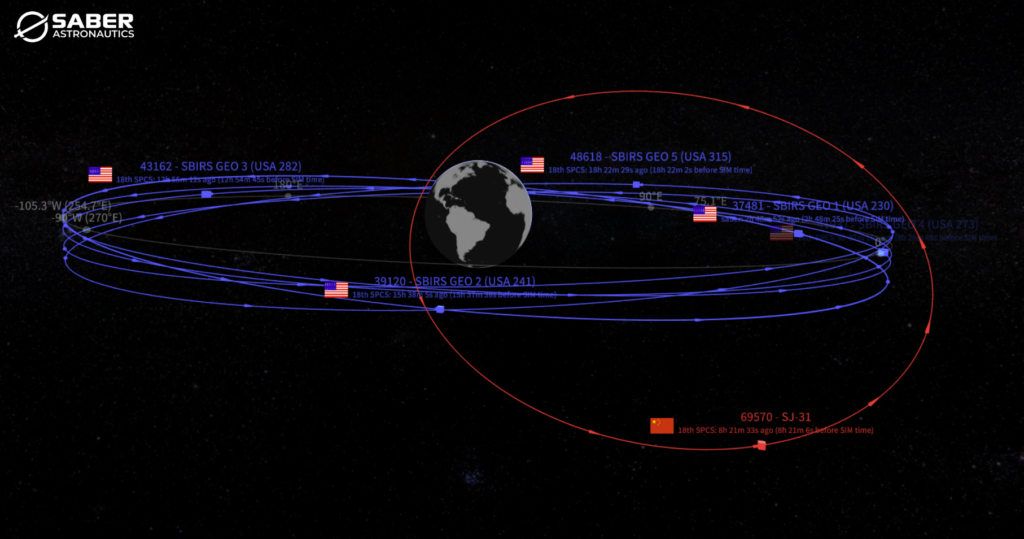
Written by Greg Gillinger On 16 June 2026, China launched a Long March 3B/E from Xichang carrying Shijian-31 (SJ-31) (69570). Initial TLE data from SpaceTrack indicates the satellite is operating in a highly elliptical orbit (HEO) with an inclination of approximately 63.4° and an eccentricity of 0.69—consistent with a Molniya-type orbit. The satellite has an orbital period of approximately 12.5 hours, completing just under two orbits per day. China has released little information on SJ-31, stating only that it will be used for “space environment detection.” Molniya orbits take advantage of Earth’s oblateness (J2 perturbation) at the critical inclination of approximately 63.4° to stabilize the Argument of Perigee over time. […]
Whoever Sees First Wins: Why ISR Is the Decisive Capability of the Next War
The next major conflict won’t be decided by the biggest platform or the newest weapon system. It will be decided by whoever can sense, understand, and act faster than the adversary. That is the central argument of the inaugural episode of The ISR Debrief, the new podcast from Integrity ISR, where host Wesley Rose sits down with Chad Hartman — Senior Vice President of Global ISR Solutions at Integrity ISR and a retired U.S. Air Force intelligence colonel who served as NATO’s targeting and collection management authority. Across more than 30 years in ISR, special operations, and targeting, Hartman has watched the character of war change — but rarely as […]
Is Russia Maneuvering to Threaten an ICEYE Satellite?
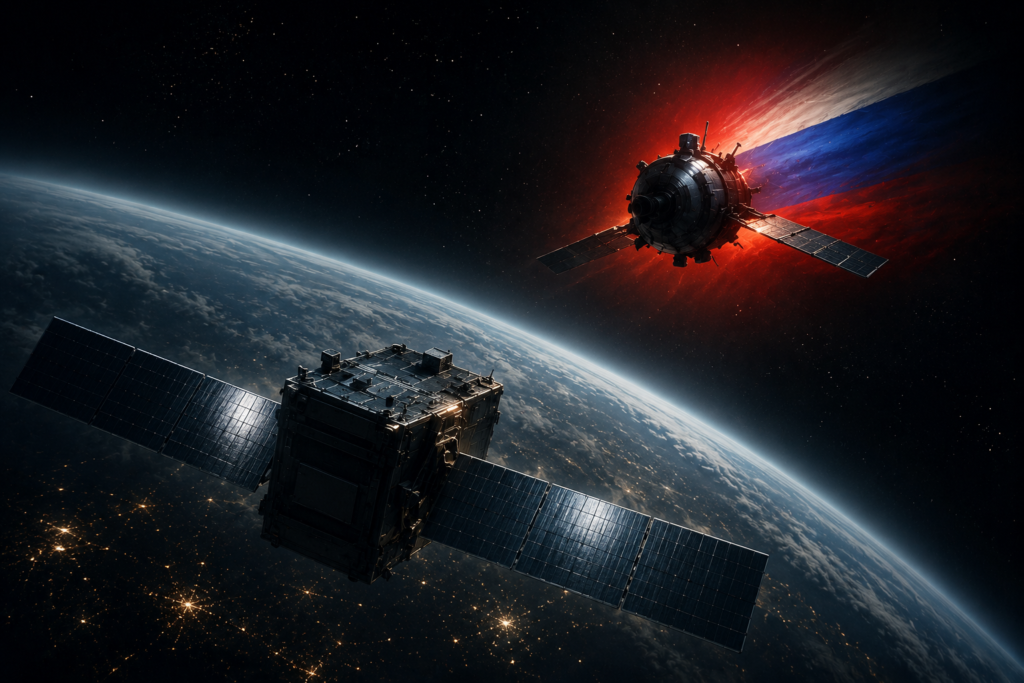
Written by Greg Gillinger EIN Presswire 22 May 2026: Russia conducted significant plane change maneuvers with at least 4 of its 6 Cosmos satellites. Plane change maneuvers are rare in space operations, especially in Low Earth Orbit (LEO) due to the required energy–which equates to a significant fuel investment. In this case, the fuel required to conduct such a maneuver is ~105-106m/sec. The maneuvers brought the 4 satellites into nearly co-planar orbits with ICEYE-X36 (59103) which is also inclined 97.8° and is a Synthetic Aperture Radar (SAR) imaging satellite. ICEYE is a Finnish-American aerospace and data company that designs, builds, and operates the world’s largest constellation of SAR satellites. ICEYE […]
 Japanese
  English
  Spanish
  Arabic
  Portuguese